Google Sheets for SEO: Workflows That Scale is useful when it helps a real reader or operator make a better decision, not when it adds another isolated SEO tactic. For arjns-style publishing, the page should explain the problem, show the practical workflow, name the risks, and give a repeatable way to review the result. A reliable SEO spreadsheet preserves raw data, uses stable keys, separates calculation from approval, exposes errors, and produces a controlled output. Move to code or a database when scale, refresh frequency, permissions, or dependencies make review unreliable.
Write formulas that fail visibly and safely
A safe SEO sheet does not turn a missing lookup into a plausible blank or publish rows without approval. Preserve raw imports, normalize in helper columns, join on stable keys, and route exceptions to QA. Use `=IF(A2="","MISSING INPUT",LOWER(TRIM(CLEAN(A2))))` for visible blanks, exact-match `XLOOKUP` with `REVIEW: NOT FOUND` for missing keys, and `=IF(OR(B2="",B2=0),"N/A",A2/B2)` for guarded ratios. Test normal, blank, duplicate, missing, malformed, and error rows. Before export, reconcile raw rows, unique keys, duplicates, unmatched rows, approvals, and output rows.
Design the workbook as a controlled handoff
A reviewer should be able to trace every exported value back to a dated raw input, a formula version, and an explicit human decision. Add a README tab with owners, refresh steps, protected ranges, definitions, and the acceptance test for the output.
- Use separate raw, reference, calculation, QA, approved-output, and change-log tabs so importing new data cannot overwrite decisions.
- Prefer named or bounded ranges when full-column formulas make large sheets slow, and archive a values-only snapshot before material formula changes.
- Move the workflow to code or a database when quotas, concurrent edits, permissions, scheduled refreshes, or dependency chains repeatedly defeat review.
Decide whether a spreadsheet is the right system
Start by separating the user need from the search engine signal. The user need is what the page must solve. The search signal is how crawlers and ranking systems understand that solution. If the page only chases the signal, it becomes thin. If it only helps the reader but hides the structure, it can be harder to discover. The right answer is a clear page with crawlable HTML, precise metadata, useful examples, internal links, and a measurable follow-up.
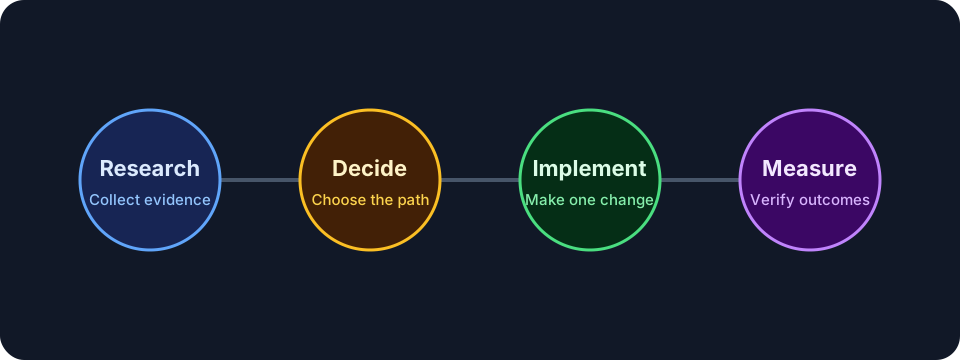
Build a controlled SEO workbook
- Define the decision, owner, inputs, refresh schedule, approved output, and acceptance checks before building formulas.
- Separate the workbook into README, raw imports, reference data, working calculations, QA, approved output, and change log tabs.
- Choose a stable key such as a normalized canonical URL or query, page, and date combination instead of using row position.
- Normalize data in helper columns while preserving original values and avoiding destructive replacements.
- Use exact-match joins, show unmatched values clearly, and hide an error only when the fallback remains meaningful.
- Add validation, protected formula ranges, named ranges, filter views, a decision owner, status, and review date.
- Create explicit QA counts for blanks, duplicates, invalid statuses, redirect chains, multiple primary keywords, and conflicting decisions.
- Export only approved rows, archive a dated snapshot, and migrate when volume, quotas, permissions, or automation becomes unreliable.
- Document the expected search intent, the page promise, and the verification method before publishing.
- Review the rendered page on mobile because cramped layouts, hidden tables, or broken controls can turn good content into a poor experience.
Safe formulas with visible failure states
Useful formulas include `=LOWER(TRIM(CLEAN(A2)))` to normalize text, `=COUNTIF($B$2:$B,B2)>1` to flag duplicates, `=IFNA(XLOOKUP(B2,Reference!A:A,Reference!B:B),"REVIEW: missing")` for visible join failures, and `=IF(C2="","MISSING",IF(LEN(C2)>60,"LONG","OK"))` for title QA. A redirect sheet should record old URL, final URL, statuses, hops, duplicates, approver, and tested date.
- Write the page brief before writing the final article.
- Name the primary query group and the reader's next action.
- Check the rendered page, not only the draft data.
- Record the verification date so later reporting has context.
Spreadsheet QA and approval checklist
- The title, H1, summary, and first section describe the same practical outcome.
- The page includes examples or decision rules a reader can apply immediately.
- Important links are crawlable anchors with natural context.
- The sitemap includes the page only when it is live and canonical.
- The page avoids claims that cannot be verified from visible content or data.
- The review date, publish date, and next measurement point are clear to the editor.
Quotas, permissions, and scale limits
Use decision rules to keep the work honest. A rule prevents the page from becoming a collection of SEO opinions and makes the review easier for another person. The rule should explain what to do when evidence is weak, when a page is too thin, when a signal conflicts with another signal, and when the safest answer is to wait for better data.
- If the page cannot answer a clear reader need, do not publish it as indexable content.
- If the technical signal conflicts with visible content, fix the visible content or remove the signal.
- If a section only repeats the title in different words, replace it with an example, checklist, or caveat.
- If a change cannot be verified, mark it as an editorial assumption rather than a completed fix.
- If a future page is scheduled, keep it out of public links and sitemaps until the publish date.
Formulas that hide data problems
- Editing imported raw data instead of preserving an auditable source tab.
- Wrapping every formula in a blank fallback that hides missing or broken joins.
- Using live import formulas as a production crawler or monitoring system.
- Sharing unrestricted spreadsheets that contain sensitive exports.
- Keeping the process in a spreadsheet after scale and concurrent editing make it unreliable.
Reconcile inputs, exceptions, and outputs
Measure this work with a short feedback loop: crawl status, sitemap visibility, impressions for the intended query group, clicks and CTR when snippets change, engagement on the page, and whether the reader continues to a related guide or tool. Do not judge success from a single day of data; search systems, crawling, and reporting all move on different timelines.
Spreadsheet QA and approval checklist: release checks
- Confirm the canonical URL, title, meta description, headings, and language alternates.
- Open the page on mobile and desktop to check spacing, tables, diagrams, and code blocks.
- Verify the page appears in the sitemap only when it is live.
- Check that images have useful alt text and do not create layout shift.
- Add internal links from related guides after the destination page is public.
Recommendation: preserve raw data and approvals: AI review prompt
Use this prompt after you have a real URL, page draft, or crawl export. It is meant to produce fixes you can review, not automatic publishing decisions.
Act as a careful SEO implementation reviewer.
Page/topic: Google Sheets for SEO: Workflows That Scale
URL or draft: [paste URL or content]
Search intent: [intent]
Review: crawlability, title, meta description, headings, content depth, examples, internal links, structured data/canonical needs, mobile UX, and measurement plan.
Return prioritized fixes with exact page sections to change.
Frequently asked questions
Which formulas are most useful for SEO?
Text cleanup, exact lookups, conditional counts, filters, regex extraction, uniqueness checks, and explicit error handling.
Can Google Sheets crawl a website reliably?
It can inspect small samples, but it is not a dependable crawler or monitoring system.
How do I prevent collaborators from breaking formulas?
Separate inputs from calculations, protect ranges, use validation and filter views, and publish only approved outputs.
When should the workflow move elsewhere?
Move when volume, scheduled refreshes, concurrent edits, permissions, auditability, or dependencies cause repeated failures.
Recommendation: preserve raw data and approvals
A strong SEO page is not only optimized for a keyword. It is reachable, understandable, useful, and honest about what it can answer. Before publishing, check the rendered page, the snippet fields, internal links, indexability, and whether a reader can act without opening five more tabs.
Revisit the page when search intent changes, when the product or platform changes, when Search Console shows new query groups, or when users repeatedly need clarification. Refreshing content should make the page more accurate and useful; it should not be a cosmetic date change.