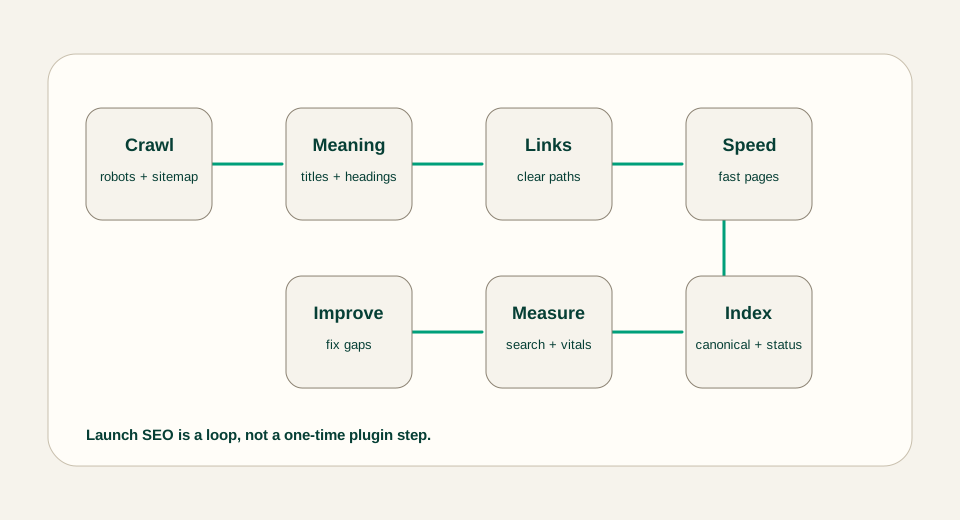
Technical SEO for a new website is mostly about removing confusion. Search engines need to access the pages, understand what each page is about, discover the important URLs, and see that the site is fast and stable enough for users. Do those basics well before chasing advanced tactics.
Check crawl access first
Start with the files and settings that decide whether crawlers can reach the site. A new website should not accidentally block public pages with robots.txt, noindex tags, password gates, broken redirects, or private preview URLs.
Use Google Search Central’s robots.txt guidance as the source of truth for crawler rules, then verify the generated file on the production hostname.
- Open the important pages in a private browser window.
- Make sure public pages return a 200 status, not a redirect loop or soft error.
- Use robots.txt to block only pages that should stay out of search.
- Add a sitemap URL when the site has stable public pages.
- Keep staging, admin, and internal routes unavailable to public visitors.
Make every page understandable
Each indexable page needs a clear job. The title, meta description, H1, opening paragraph, and internal links should point in the same direction. If those signals disagree, the page is harder to rank and harder for readers to trust.
- Write one descriptive title for each page.
- Keep the meta description specific to the page, not the whole website.
- Use one clear H1 and structured H2 sections.
- Avoid duplicate titles across important pages.
- Use descriptive alt text when images explain useful information.
Use stable URLs and internal links
New websites often lose clarity when URLs keep changing. Pick readable slugs early, keep them stable after publishing, and link from the homepage, blog index, category pages, and related guide sections where the connection is useful.
Internal links should help the reader choose the next useful page. Do not add links only to increase count. A small number of relevant links is better than a large block of unrelated links.
Cover performance basics before launch
Performance is part of technical SEO because slow pages reduce user experience and make crawling less efficient. Keep article pages server-rendered where possible, avoid unnecessary client JavaScript, compress images, and check that fonts do not cause avoidable layout shift.
Common launch failures
Most early SEO failures are not advanced ranking problems. They are simple publishing mistakes: the wrong domain is indexed, important pages are missing from navigation, metadata is duplicated, redirects point to the homepage, or a private route leaks into the sitemap. A launch review should look for these practical failures before worrying about backlinks or complex schema.
- Redirect old or duplicate URLs to the closest matching final page.
- Keep only final, canonical URLs in the sitemap.
- Use the same canonical and hreflang logic across all translations.
- Make sure the blog index links to the latest useful guides.
- Confirm removed routes return 404 instead of redirecting to unrelated pages.
Prepare indexing and measurement
After launch, measure what search engines and users actually see. Submit the sitemap, inspect the most important URLs, watch indexing coverage, and track whether pages receive impressions for the topics they were written to answer.
- Check canonical URLs on every public page.
- Confirm language alternates when translations exist.
- Review the generated page metadata in the browser.
- Monitor important pages after launch instead of assuming they are indexed.
Useful tools on arjns
Use the Meta Tag Preview Tool before publishing a page and the Robots.txt Generator when you need a simple crawler instruction file. These tools do not replace judgment, but they reduce common formatting mistakes.
For larger reviews, use the Canonical Checker to compare preferred URLs and the Redirect Chain Checker to keep URL changes short and secure. The point is not to collect tool scores; it is to make the site easier to crawl, understand, and maintain.
Final recommendation
Launch with the basics correct: crawl access, clear page meaning, stable URLs, useful internal links, acceptable speed, and measurement. A website with clean fundamentals is easier to improve than one that starts with hidden pages, duplicate metadata, and unclear routes.