Technical SEO is the engineering layer that lets search engines discover, crawl, render, understand, and index the right URLs. It does not replace useful content, but weak technical foundations can stop useful content from being seen. A technical SEO review should therefore start with access and status codes, then move into rendering, canonical signals, structured data, performance, and monitoring.
What this page must do
The most useful technical SEO work is boring in the best way: public pages return the right status, blocked areas stay blocked, canonical pages are consistent, internal links use crawlable anchors, XML sitemaps include only canonical live URLs, and important content exists in the rendered HTML. Once those basics are correct, advanced work such as schema validation, log analysis, crawl budget, and migration planning becomes much easier.
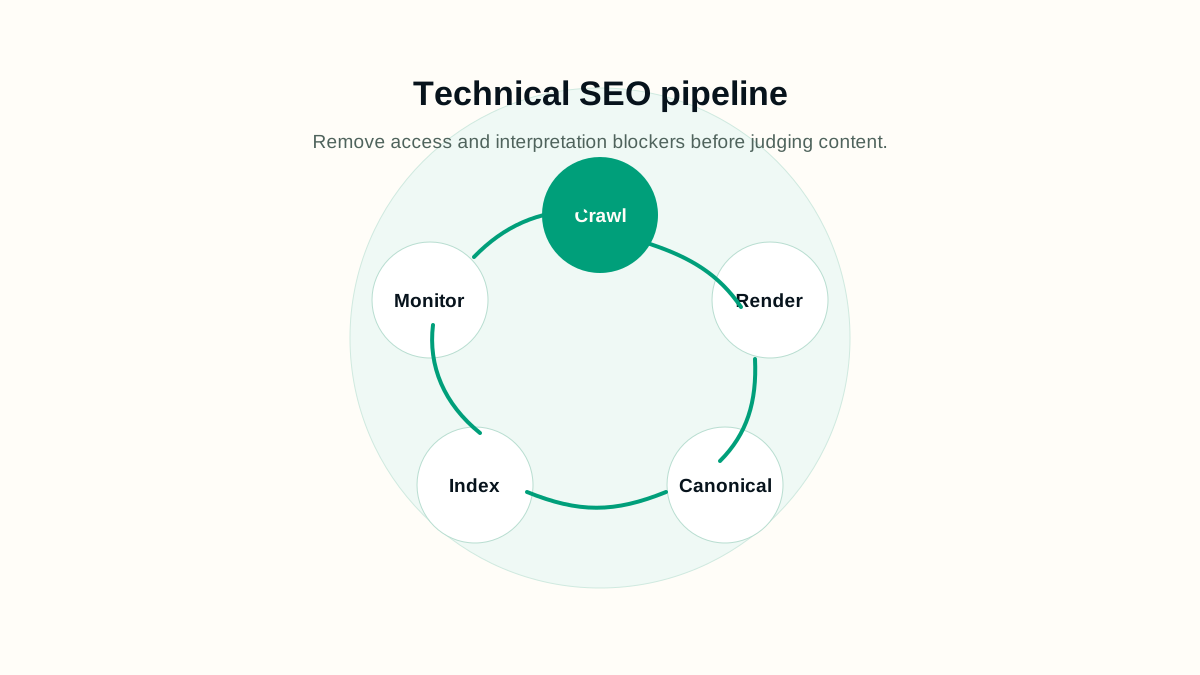
A practical workflow
- Crawl the site and group URLs by status: 200, 3xx, 4xx, 5xx, blocked, and noindex.
- Check whether important templates render meaningful HTML without relying on delayed client-only content.
- Confirm every indexable page has a self-consistent canonical, title, description, and hreflang where relevant.
- Compare navigation links, sitemap URLs, and canonical URLs for conflicts.
- Validate structured data only after the visible content supports the same meaning.
- Monitor Search Console after changes because crawling and indexing are not instant.
Working example
Imagine the page is being prepared for a real publishing queue. The editor has one URL, one primary intent, a sitemap rule, and a follow-up date. For technical seo guide, the useful work is to decide what must be visible before launch, what can be measured after launch, and which signals would prove that the page is helping users instead of only adding another URL.
- Write the page brief before writing the final article.
- Name the primary query group and the reader's next action.
- Check the rendered page, not only the draft data.
- Record the verification date so later reporting has context.
Implementation checklist
- Robots.txt does not block CSS, JavaScript, images, or pages needed for indexing.
- Sitemap files return 200, use absolute canonical URLs, and exclude redirects and future pages.
- Canonical tags do not point every page to the homepage or to unrelated URLs.
- Pagination, filters, language variants, and duplicate paths have a deliberate indexability rule.
- Core templates pass basic mobile layout, performance, and accessibility checks.
- Error pages are real 404s, not soft 404s with thin placeholder content.
Decision rules
Use decision rules to keep the work honest. A rule prevents the page from becoming a collection of SEO opinions and makes the review easier for another person. The rule should explain what to do when evidence is weak, when a page is too thin, when a signal conflicts with another signal, and when the safest answer is to wait for better data.
- If the page cannot answer a clear reader need, do not publish it as indexable content.
- If the technical signal conflicts with visible content, fix the visible content or remove the signal.
- If a section only repeats the title in different words, replace it with an example, checklist, or caveat.
- If a change cannot be verified, mark it as an editorial assumption rather than a completed fix.
- If a future page is scheduled, keep it out of public links and sitemaps until the publish date.
Common mistakes
- Fixing schema while the page is blocked, redirected, noindexed, or not linked internally.
- Submitting every discovered URL in a sitemap instead of only canonical live URLs.
- Assuming JavaScript-rendered content is visible without checking the rendered HTML.
- Changing many technical signals at once and then being unable to identify which fix helped.
- Ignoring server errors, redirect chains, and broken internal links because the homepage looks fine.
How to measure it
Measure technical SEO by looking for fewer invalid URLs, fewer duplicate or alternate conflicts, improved crawl success, faster rendering, stable canonical selection, and cleaner sitemap coverage. The best result is often not a ranking jump the next morning; it is a site where search engines spend less effort understanding basic access rules.
Release checklist
- Confirm the canonical URL, title, meta description, headings, and language alternates.
- Open the page on mobile and desktop to check spacing, tables, diagrams, and code blocks.
- Verify the page appears in the sitemap only when it is live.
- Check that images have useful alt text and do not create layout shift.
- Add internal links from related guides after the destination page is public.
AI review prompt
Use this prompt after you have a real URL, page draft, or crawl export. It is meant to produce fixes you can review, not automatic publishing decisions.
Act as a technical SEO engineer.
Inputs: crawl export, robots.txt, sitemap URLs, canonical sample, Search Console notes.
Find: indexability conflicts, bad status codes, blocked resources, canonical mismatch, sitemap pollution, rendering risk, and mobile layout risk.
Output a fix order with verification steps for each issue.
Final review
A strong SEO page is not only optimized for a keyword. It is reachable, understandable, useful, and honest about what it can answer. Before publishing, check the rendered page, the snippet fields, internal links, indexability, and whether a reader can act without opening five more tabs.
Revisit the page when search intent changes, when the product or platform changes, when Search Console shows new query groups, or when users repeatedly need clarification. Refreshing content should make the page more accurate and useful; it should not be a cosmetic date change.