Long-Tail Keywords: How to Find and Use Them is useful when it helps a real reader or operator make a better decision, not when it adds another isolated SEO tactic. For arjns-style publishing, the page should explain the problem, show the practical workflow, name the risks, and give a repeatable way to review the result. Define long-tail queries by their position in the search-demand curve, not a fixed word count. Use them to discover specific reader needs, then let intent, answer depth, existing coverage, and result patterns decide whether a query deserves a page, a section, or no new URL.
What makes a keyword long-tail
A long-tail keyword is a relatively infrequent search need within a topic's demand distribution, not simply a phrase containing three or more words. Its value comes from specificity: a modifier may reveal the reader's situation, constraint, stage, or desired action. That specificity helps shape an answer, but it does not automatically justify a separate URL. Search intent, required answer depth, result overlap, and existing coverage determine whether the best destination is a page, a section, a tool, or no new content.
What a defensible long-tail map contains
The finished map should preserve meaningful modifiers while preventing near-duplicate briefs from entering the publishing queue.
- Separate modifiers that change the task from wording variants that can share one answer.
- Compare existing URLs before creating a brief, including sections that already satisfy the narrower need.
- Record why a query became a page, section, tool, refresh, or rejection so the decision can be reviewed later.
Diagnose the specific search task
Start by separating the user need from the search engine signal. The user need is what the page must solve. The search signal is how crawlers and ranking systems understand that solution. If the page only chases the signal, it becomes thin. If it only helps the reader but hides the structure, it can be harder to discover. The right answer is a clear page with crawlable HTML, precise metadata, useful examples, internal links, and a measurable follow-up.
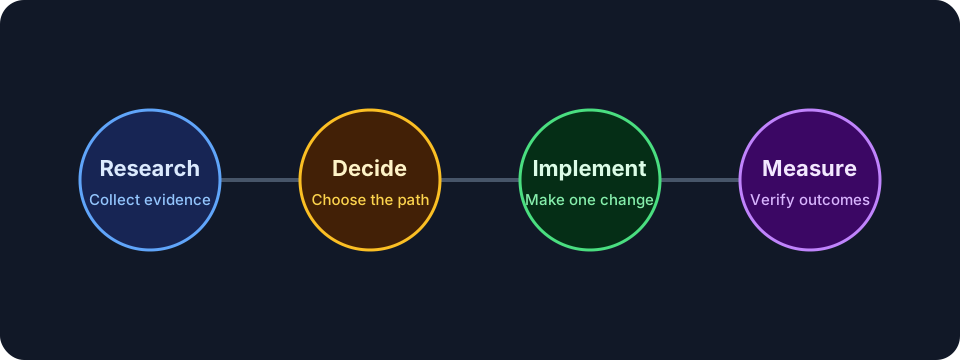
Find, normalize, and map long-tail demand
- Define the audience and practical problem before exporting keyword suggestions.
- Collect language from search performance, internal search, support questions, communities, autocomplete, and related searches.
- Normalize duplicates while preserving modifiers that can change the user's task.
- Label each query as learn, compare, diagnose, complete, locate, or buy.
- Map every query to an existing page before proposing another URL.
- Compare result types and overlap, then choose page, section, tool, or no page.
- Document the expected search intent, the page promise, and the verification method before publishing.
- Review the rendered page on mobile because cramped layouts, hidden tables, or broken controls can turn good content into a poor experience.
Worked example: page, section, tool, or reject
Map 'technical SEO checklist' to the existing checklist page. Treat 'technical SEO checklist for a small site' as a section because it serves the same task with a narrower constraint. A request for a reusable audit template may justify a separate tool, while an agency-selection query is outside a blog-first site's scope. Track the chosen page's full relevant query mix and useful outcomes; do not judge the cluster by one exact phrase.
- Write the page brief before writing the final article.
- Name the primary query group and the reader's next action.
- Check the rendered page, not only the draft data.
- Record the verification date so later reporting has context.
Long-tail intent validation checklist
- The title, H1, summary, and first section describe the same practical outcome.
- The page includes examples or decision rules a reader can apply immediately.
- Important links are crawlable anchors with natural context.
- The sitemap includes the page only when it is live and canonical.
- The page avoids claims that cannot be verified from visible content or data.
- The review date, publish date, and next measurement point are clear to the editor.
Volume, overlap, and evidence limits
Use decision rules to keep the work honest. A rule prevents the page from becoming a collection of SEO opinions and makes the review easier for another person. The rule should explain what to do when evidence is weak, when a page is too thin, when a signal conflicts with another signal, and when the safest answer is to wait for better data.
- If the page cannot answer a clear reader need, do not publish it as indexable content.
- If the technical signal conflicts with visible content, fix the visible content or remove the signal.
- If a section only repeats the title in different words, replace it with an example, checklist, or caveat.
- If a change cannot be verified, mark it as an editorial assumption rather than a completed fix.
- If a future page is scheduled, keep it out of public links and sitemaps until the publish date.
When not to create a long-tail page
Do not create a page when the query is outside the site's editorial scope, when its answer is a sentence inside an established guide, or when the modifier does not change the task. A reported zero volume is not by itself a rejection, and a low difficulty score is not by itself approval. Use direct audience evidence and the page map to make the decision.
Long-tail research mistakes
- Defining every phrase with three or more words as long-tail.
- Assuming low volume always means low competition or high conversion.
- Publishing one thin page for every modifier.
- Choosing a query only because a tool labels it easy.
- Ignoring useful audience questions because a tool reports zero volume.
Measure the whole query cluster
Measure this work with a short feedback loop: crawl status, sitemap visibility, impressions for the intended query group, clicks and CTR when snippets change, engagement on the page, and whether the reader continues to a related guide or tool. Do not judge success from a single day of data; search systems, crawling, and reporting all move on different timelines.
Long-tail intent validation checklist: release checks
- Confirm the canonical URL, title, meta description, headings, and language alternates.
- Open the page on mobile and desktop to check spacing, tables, diagrams, and code blocks.
- Verify the page appears in the sitemap only when it is live.
- Check that images have useful alt text and do not create layout shift.
- Add internal links from related guides after the destination page is public.
Recommendation: publish fewer, stronger destinations: AI review prompt
Use this prompt after you have a real URL, page draft, or crawl export. It is meant to produce fixes you can review, not automatic publishing decisions.
Act as a careful SEO implementation reviewer.
Page/topic: Long-Tail Keywords: How to Find and Use Them
URL or draft: [paste URL or content]
Search intent: [intent]
Review: crawlability, title, meta description, headings, content depth, examples, internal links, structured data/canonical needs, mobile UX, and measurement plan.
Return prioritized fixes with exact page sections to change.
Frequently asked questions
Are long-tail keywords always long phrases?
No. The term describes low-frequency demand, not a required number of words.
Are long-tail keywords always easier?
No. Difficulty depends on intent, competing pages, site relevance, and the answer quality required.
Should each long-tail query have a page?
Usually not. Close variants that serve the same task normally belong on one strong page.
Where can useful ideas come from?
Use search performance, internal search, support questions, audience language, autocomplete, and related searches.
Recommendation: publish fewer, stronger destinations
A strong SEO page is not only optimized for a keyword. It is reachable, understandable, useful, and honest about what it can answer. Before publishing, check the rendered page, the snippet fields, internal links, indexability, and whether a reader can act without opening five more tabs.
Revisit the page when search intent changes, when the product or platform changes, when Search Console shows new query groups, or when users repeatedly need clarification. Refreshing content should make the page more accurate and useful; it should not be a cosmetic date change.