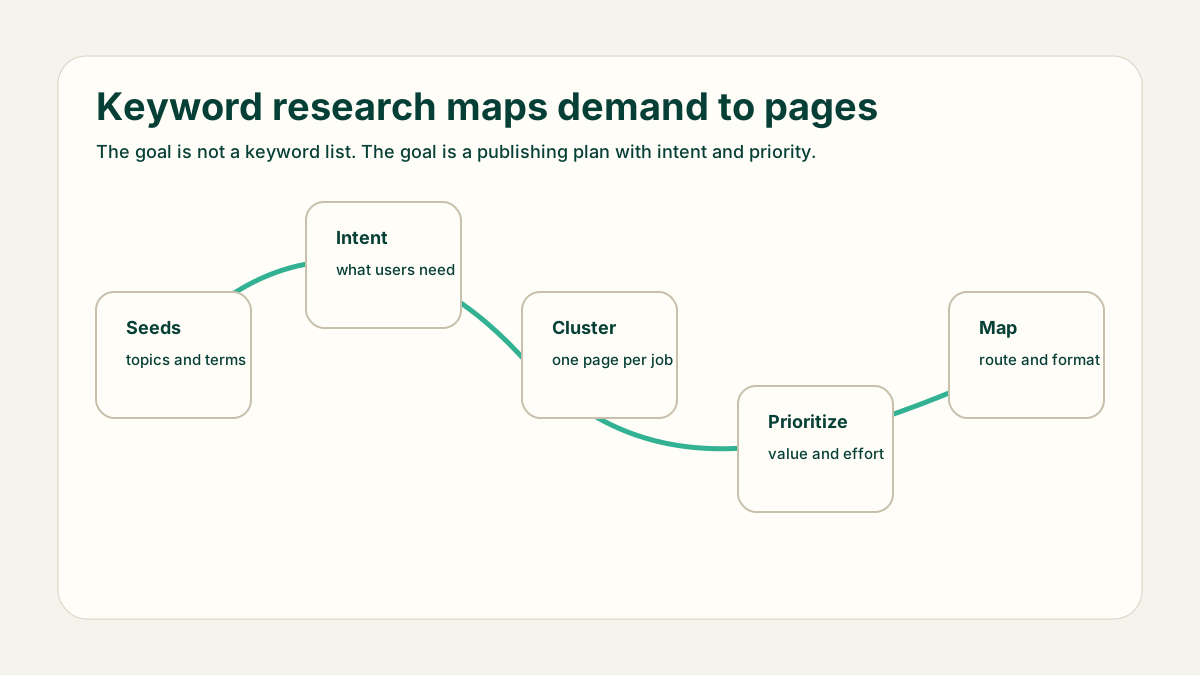
Keyword research is not the work of collecting the biggest list of search terms. It is the work of deciding which pages should exist, what each page should help the reader do, and which query group each page should answer. The output should be a prioritized content map, not a spreadsheet that nobody uses.
Start with seed terms
Seed terms are the plain words people already use for the topic. For an SEO series, seeds might include search engines, keyword research, on-page SEO, technical SEO, backlinks, sitemaps, and Search Console. Add variants, questions, and beginner phrases, but keep the original topic visible so the research does not drift.
Read search intent
Intent decides the page format. A definition query may need a short explanation and examples. A beginner guide needs a workflow. A tool query needs an interface. A checklist query needs ordered actions. If two keywords have the same intent, they usually belong on one strong page instead of two thin pages.
- Informational intent: explain, define, compare, or teach.
- Practical intent: show steps, templates, examples, and checks.
- Tool intent: provide an interactive result before long copy.
- Commercial intent: compare options without turning the site into a sales page.
Cluster keywords by job
A cluster is a group of terms that can be answered by the same page. The safest rule is one page per reader job. Do not split spelling variants, plural forms, and close synonyms into separate articles. Do split topics when the reader needs a different workflow, such as keyword research versus content optimization.
Cluster example
Pillar: /blog/seo/seo-guide
Spoke: /blog/seo/how-search-engines-work
Spoke: /blog/seo/keyword-research
Spoke: /blog/seo/content-optimization
Spoke: /blog/seo/on-page-seo
Internal link rule: pillar introduces the workflow, spokes solve one job deeply
Prioritize pages
Search volume is useful, but it should not be the only input. Prioritize by relevance to the site, reader usefulness, connection to existing pages, ability to make a better resource, and publishing effort. A lower-volume page can be worth building early if it supports the whole topic cluster.
Map keywords to routes
Every chosen cluster should map to a stable route, a title promise, a page format, and internal links. This prevents keyword research from becoming detached from implementation. For a bilingual site, keep the same slug for English and Hindi so alternate URLs remain simple.
Turn research into a brief
A keyword only becomes useful when it changes the page plan. Write a short brief before drafting: primary intent, secondary questions, page type, sections required, examples needed, internal links, and the reason this page should exist on this site. If the brief sounds like every other page on the web, the page is not ready.
Page brief
Primary intent: learn how search engines process a page
Reader level: beginner
Must answer: discovery, crawl, render, index, serve
Useful example: URL inspection debugging order
Internal links: SEO guide, technical SEO checklist, sitemap tool
Do not include: ranking promises or copied definitions
Prioritization scorecard
A simple scorecard keeps keyword research honest. Give each cluster a rough score for relevance, usefulness, confidence, effort, and internal-link fit. The best early pages are not always the highest-volume terms; they are the pages you can answer well, connect naturally, and maintain over time.
- Relevance: does this topic belong on this site?
- Usefulness: will the reader leave with a practical next step?
- Confidence: can you add experience, examples, or a clearer workflow?
- Effort: can the page be built and kept current without becoming stale?
- Internal fit: does it connect to existing guides or tools?
Use the scorecard to decide what not to publish yet. If a topic is relevant but you cannot add examples, save it until you can. If the topic has search demand but no internal fit, wait until the supporting pages exist. A smaller cluster with strong answers is better than a wide calendar full of shallow pages.
Avoid common mistakes
- Do not create separate pages for every keyword variation.
- Do not chase high-volume topics that the site cannot answer well.
- Do not ignore intent because a keyword looks attractive.
- Do not publish clusters without internal links between the pages.
- Do not treat difficulty scores as exact truth; use them as rough caution.
Final recommendation
Finish keyword research with a page map: route, intent, title promise, content format, related links, and publish priority. That map is easier to build from than a raw keyword export, and it keeps the site focused on useful pages.