Link building is the work of earning and managing references from other pages. Links can help discovery and can signal that a page is worth referencing, but the safest long-term approach is not to manufacture artificial popularity. Build pages that deserve citations, make them easy to reference, and avoid tactics that exist mainly to manipulate ranking systems.
What this page must do
Good link building starts before outreach. A weak page with no original value gives people no reason to link. A strong page may include original examples, tools, diagrams, data, templates, calculators, or a practical explanation that saves someone time. Outreach then becomes specific: who would benefit from this resource, what page of theirs would it improve, and why is the suggested reference useful to their reader?
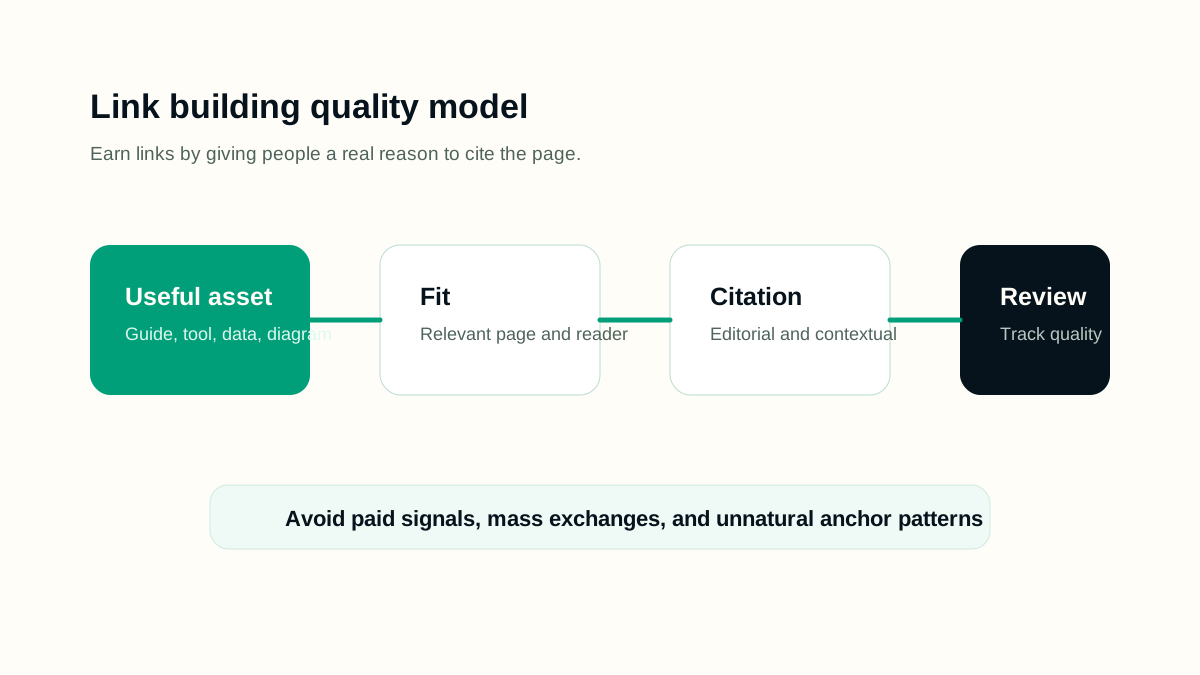
A practical workflow
- Create a link-worthy asset: a guide, tool, data point, diagram, template, or original explanation.
- Identify pages where that asset genuinely improves the reader's next step.
- Write outreach that is specific to the page, not a generic mass email.
- Qualify commercial, sponsored, or user-generated links correctly instead of trying to pass hidden signals.
- Track earned links, lost links, anchor text, destination URLs, and referral usefulness.
- Use internal links to distribute context from your own related guides before chasing external links.
Working example
Imagine the page is being prepared for a real publishing queue. The editor has one URL, one primary intent, a sitemap rule, and a follow-up date. For link building for seo, the useful work is to decide what must be visible before launch, what can be measured after launch, and which signals would prove that the page is helping users instead of only adding another URL.
- Write the page brief before writing the final article.
- Name the primary query group and the reader's next action.
- Check the rendered page, not only the draft data.
- Record the verification date so later reporting has context.
Implementation checklist
- The target page gives a clear reason for another writer to cite it.
- The outreach message names the exact page and the exact improvement.
- Anchor text sounds natural and does not force repeated exact-match phrases.
- Paid or sponsored placements use appropriate link attributes.
- Broken or changed destination URLs are redirected to the most relevant replacement.
- Backlink review separates useful editorial mentions from spammy noise.
Decision rules
Use decision rules to keep the work honest. A rule prevents the page from becoming a collection of SEO opinions and makes the review easier for another person. The rule should explain what to do when evidence is weak, when a page is too thin, when a signal conflicts with another signal, and when the safest answer is to wait for better data.
- If the page cannot answer a clear reader need, do not publish it as indexable content.
- If the technical signal conflicts with visible content, fix the visible content or remove the signal.
- If a section only repeats the title in different words, replace it with an example, checklist, or caveat.
- If a change cannot be verified, mark it as an editorial assumption rather than a completed fix.
- If a future page is scheduled, keep it out of public links and sitemaps until the publish date.
Common mistakes
- Buying links or exchanging links at scale for ranking signals.
- Sending the same vague outreach to hundreds of unrelated sites.
- Pointing every link to the homepage when a deeper guide is more relevant.
- Ignoring lost links after changing URLs during a redesign or migration.
- Treating every backlink as valuable just because a tool reports it.
How to measure it
Measure link building with quality, relevance, referral behavior, and retained value. Count how many links come from relevant pages, how many send useful visitors, which pages attract citations naturally, and whether old links still resolve correctly. A smaller number of useful editorial links is usually more durable than a large report full of weak placements.
Release checklist
- Confirm the canonical URL, title, meta description, headings, and language alternates.
- Open the page on mobile and desktop to check spacing, tables, diagrams, and code blocks.
- Verify the page appears in the sitemap only when it is live.
- Check that images have useful alt text and do not create layout shift.
- Add internal links from related guides after the destination page is public.
AI review prompt
Use this prompt after you have a real URL, page draft, or crawl export. It is meant to produce fixes you can review, not automatic publishing decisions.
Act as a link quality reviewer.
Asset URL: [URL]
Target topic: [topic]
Review whether this asset deserves citations. Suggest: better examples, data, diagrams, internal links, outreach targets by page type, and risks to avoid.
Do not suggest buying links, mass exchanges, or spam comments.
Final review
A strong SEO page is not only optimized for a keyword. It is reachable, understandable, useful, and honest about what it can answer. Before publishing, check the rendered page, the snippet fields, internal links, indexability, and whether a reader can act without opening five more tabs.
Revisit the page when search intent changes, when the product or platform changes, when Search Console shows new query groups, or when users repeatedly need clarification. Refreshing content should make the page more accurate and useful; it should not be a cosmetic date change.