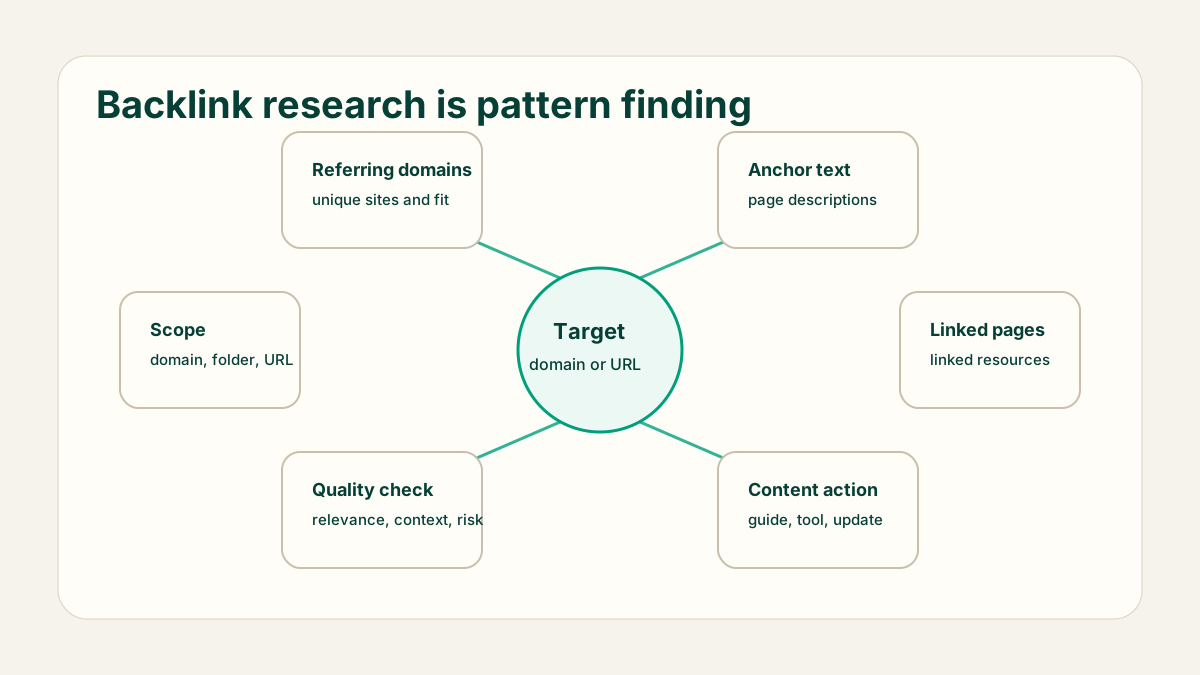
Backlinks are links from other websites to a page. They can help you understand which pages earn references, what topics attract attention, and where a site may have authority. The useful part is not counting links. The useful part is finding patterns you can act on: which pages people cite, how they describe those pages, and what kind of resource deserves the next link.
Choose the right scope
Start by deciding whether you need backlinks for a whole domain, a subdomain, a folder, or one URL. A domain check shows broad authority patterns. A page check shows why a specific article, tool, or resource earned links. A folder check can reveal whether a blog, glossary, docs section, or tool collection is carrying most of the references.
- Use a domain check when you need the overall link profile.
- Use a URL check when you want to understand why one page earned references.
- Use a folder check when you are planning a content hub or tool category.
- Record the scope before comparing numbers, because different scopes answer different questions.
Use a backlink checker
Enter the domain or URL into a backlink checker and review referring domains, linked pages, anchor text, link targets, and first-seen or lost-link dates when available. Free tools usually show a limited sample, which is enough for direction but not enough for a complete audit. Treat the first pass as research, then verify important links manually before making decisions.
Backlink review sheet
URL checked:
Scope: domain | folder | page
Referring domains:
Strongest linked page:
Common anchor pattern:
Link context:
Quality notes:
Action: create | improve | redirect | ignore
Read the metrics carefully
- Referring domains are usually more useful than raw backlink count.
- Linked pages show what type of content attracts references.
- Anchor text can reveal how other sites describe the page.
- New and lost links help explain recent movement.
- Low-quality repeated links should not drive content decisions.
Separate quantity from quality
A page with fewer links can be more useful to study than a page with many repeated sidebar or directory links. Look for editorial context, topical relevance, unique referring domains, natural anchor text, and whether the link points to a page that actually solves a problem. Ignore patterns that would not help your audience build something better.
- Prefer unique, relevant referring domains over repeated links from the same template.
- Look at the paragraph around the link, not only the anchor text.
- Check whether the linked page is a guide, data source, tool, template, definition, or visual resource.
- Do not let spammy links define your content plan.
Turn backlink data into actions
Look for linkable formats: original data, calculators, templates, checklists, definitions, visual explanations, and tools. If several pages in a topic earn links because they solve a practical problem, build a better version for your audience instead of copying their structure. The output should be an editorial decision, not a copied outline.
Find content opportunities
Backlink research is especially useful when planning new articles and tools. If many references point to a definition page, the opportunity may be a clearer beginner guide. If references point to calculators or generators, the opportunity may be a faster tool with better validation and a stronger explanation. If links point to dated resources, the opportunity may be a refreshed page with current examples.
- Build a guide when people link because they need a clear explanation.
- Build a tool when people link because they need to generate, validate, compare, or calculate something.
- Build a diagram when people struggle to understand a process from text alone.
- Improve an existing page when the topic already exists but misses examples, freshness, or internal links.
Use outreach carefully
Outreach works only when the page genuinely helps the person receiving it. Do not send mass templates based on a backlink export. First check whether the site is relevant, whether the old link is broken or outdated, and whether your page gives a better answer. A short note with the exact reason is better than a long pitch.
Avoid common mistakes
- Do not judge a site only by total backlinks.
- Do not copy outreach targets without checking relevance.
- Do not ignore whether links point to the homepage or a specific resource.
- Do not treat a small free-tool sample as a complete link profile.
- Do not assume every linked page is worth copying; some pages earn links for reasons that do not apply to your audience.
Final recommendation
Use backlink research to learn what people cite and why. The best next step is usually a stronger page, a useful tool, a clearer diagram, or a refreshed resource that deserves references on its own. Measure the outcome later by checking whether the page earns relevant links, better internal discovery, and search queries that match the intent you planned.