Core Web Vitals measure real user experience through loading performance, interaction responsiveness, and visual stability. They matter for users first and SEO second. A fast page helps visitors trust that content is usable, and a stable interface prevents frustration while people read, click, or complete a task.
What this page must do
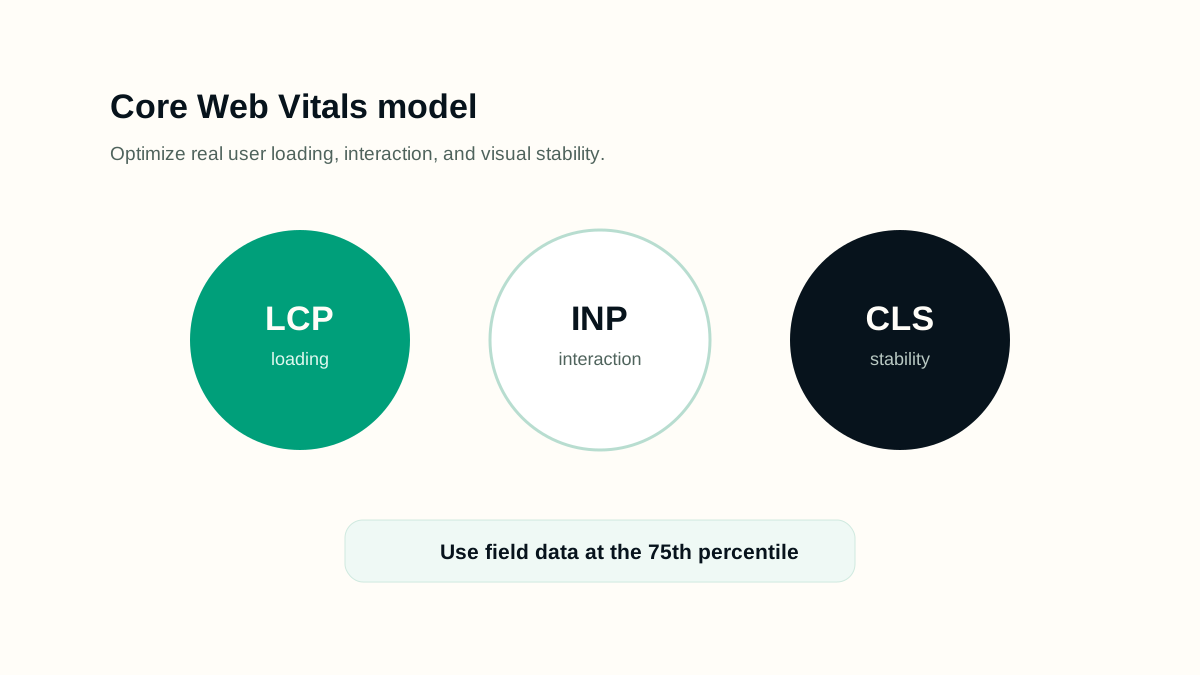
Focus on the current stable metrics: LCP for the largest visible content element, INP for responsiveness after interaction, and CLS for unexpected layout movement. Use lab tools during development, but use field data to understand what real users experience across devices and network conditions.
A practical workflow
- Identify the page template and the likely LCP element on mobile and desktop.
- Optimize server response, render path, critical CSS, fonts, and hero image delivery.
- Reduce main-thread work and slow event handlers that hurt INP.
- Reserve space for images, embeds, ads, and dynamic UI to protect CLS.
- Compare lab traces with field data before prioritizing expensive changes.
- Track improvements by template, not only by one perfect URL.
Working example
Imagine the page is being prepared for a real publishing queue. The editor has one URL, one primary intent, a sitemap rule, and a follow-up date. For core web vitals and seo, the useful work is to decide what must be visible before launch, what can be measured after launch, and which signals would prove that the page is helping users instead of only adding another URL.
- Write the page brief before writing the final article.
- Name the primary query group and the reader's next action.
- Check the rendered page, not only the draft data.
- Record the verification date so later reporting has context.
Implementation checklist
- The LCP element is useful content, not a decorative asset.
- Hero images use appropriate dimensions, formats, priority, and compression.
- Fonts do not cause large invisible text delays or shifts.
- Buttons, filters, forms, and menus respond quickly after user input.
- Images and embeds have stable dimensions.
- Performance work does not remove useful content or accessibility features.
Decision rules
Use decision rules to keep the work honest. A rule prevents the page from becoming a collection of SEO opinions and makes the review easier for another person. The rule should explain what to do when evidence is weak, when a page is too thin, when a signal conflicts with another signal, and when the safest answer is to wait for better data.
- If the page cannot answer a clear reader need, do not publish it as indexable content.
- If the technical signal conflicts with visible content, fix the visible content or remove the signal.
- If a section only repeats the title in different words, replace it with an example, checklist, or caveat.
- If a change cannot be verified, mark it as an editorial assumption rather than a completed fix.
- If a future page is scheduled, keep it out of public links and sitemaps until the publish date.
Common mistakes
- Optimizing only a desktop Lighthouse score while mobile field data is poor.
- Compressing images so heavily that screenshots or diagrams become unreadable.
- Adding animation that competes with reading or causes layout shifts.
- Ignoring third-party scripts because the site code looks small.
- Treating performance as a one-time launch task.
How to measure it
Measure Core Web Vitals at the 75th percentile across mobile and desktop where data is available. Use lab tools to debug, field data to prioritize, and template-level tracking to avoid fixing one URL while the rest of the site remains slow.
Release checklist
- Confirm the canonical URL, title, meta description, headings, and language alternates.
- Open the page on mobile and desktop to check spacing, tables, diagrams, and code blocks.
- Verify the page appears in the sitemap only when it is live.
- Check that images have useful alt text and do not create layout shift.
- Add internal links from related guides after the destination page is public.
AI review prompt
Use this prompt after you have a real URL, page draft, or crawl export. It is meant to produce fixes you can review, not automatic publishing decisions.
Act as a Core Web Vitals reviewer.
Page URL: [URL]
Field data: [LCP/INP/CLS if available]
Lab notes: [summary]
Identify likely LCP element, INP bottlenecks, CLS causes, quick wins, deeper fixes, and verification steps.
Final review
A strong SEO page is not only optimized for a keyword. It is reachable, understandable, useful, and honest about what it can answer. Before publishing, check the rendered page, the snippet fields, internal links, indexability, and whether a reader can act without opening five more tabs.
Revisit the page when search intent changes, when the product or platform changes, when Search Console shows new query groups, or when users repeatedly need clarification. Refreshing content should make the page more accurate and useful; it should not be a cosmetic date change.