The best website stack in 2026 is not the one with the most tools. It is the one that helps you publish quickly, keeps pages fast, makes content easy to find, and remains understandable after the initial launch. For a portfolio, blog, or small product site, simplicity is a technical advantage.
The recommended stack
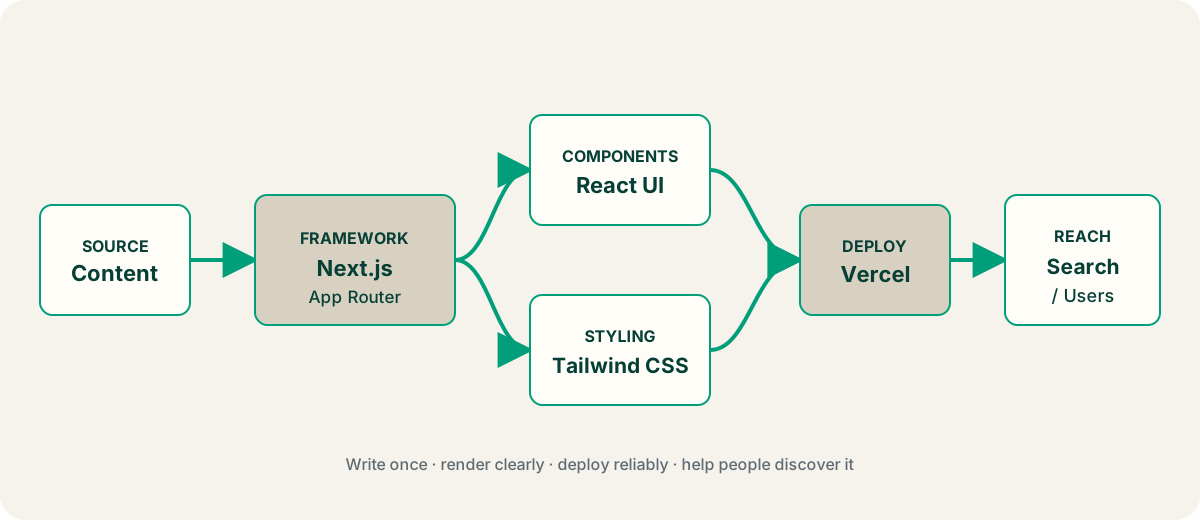
A strong default is Next.js with the App Router, React for interactive UI, Tailwind CSS for styling, repository-based content, responsive SVG diagrams, and Vercel for deployment. This combination supports static content, dynamic tools, metadata, and internationalized routes inside one application.
- Next.js App Router for pages, layouts, metadata, and server rendering.
- React for components and focused client-side interactions.
- Tailwind CSS for a small, consistent styling system.
- Typed repository content for reviewable posts and translations.
- Vercel for previews, deployment, and delivery close to users.
Why Next.js still fits
Next.js is useful when a site needs content pages, dynamic routes, metadata, image handling, and a few interactive tools. Server Components let most article code stay on the server, while Client Components can be reserved for interfaces that actually need browser state or events.
The App Router also keeps the portfolio, blog, language variants, and tools in one routing model. That reduces integration work for the first release and leaves room to add caching, a data source, or richer application behavior only when the product requires it.
Use repository-based content first
Repository-based content is easy to review, version, translate, and deploy alongside the components that render it. A typed block model gives articles a predictable structure for paragraphs, headings, lists, code, and diagrams without requiring a database or a browser-based editor.
This is not a permanent rejection of MDX or a CMS. Move to one when non-technical editors need to publish independently, editorial workflow becomes complex, or the volume of content makes code review inconvenient. Until then, files in the repository are a direct and dependable publishing system.
Make performance and SEO choices early
Performance and SEO start with architecture, not with a plugin added at the end. Render article content on the server, keep client-side JavaScript focused, use stable URLs, and provide useful metadata in the same language as each page.
- Use readable URLs and keep published slugs stable.
- Pre-render content pages whenever the content is known at build time.
- Write a unique title and summary for every translation.
- Use descriptive headings and alt text that explain the page structure.
- Prefer responsive SVG diagrams over heavy decorative images.
- Load interactive JavaScript only for tools and controls that need it.
A simple route structure
Keep routes predictable for readers and search engines. English can remain the default, while Hindi uses a clear locale prefix and the same article slug so translation relationships are easy to understand.
/
/blog
/blog/best-tech-to-build-website-in-2026
/hi/blog/best-tech-to-build-website-in-2026
/tools/campaign-url-builder
What to avoid
Avoid adding a database, headless CMS, analytics pipeline, search service, and large plugin collection before the site has enough content or traffic to justify them. Each service adds configuration, permissions, failure modes, and maintenance work.
Also avoid turning every component into a Client Component. A content site should send useful HTML first and add browser code only where interaction improves the task. Complexity should follow observed publishing and product needs, not guesses about a distant future.
When to add complexity
Add infrastructure only when the current workflow is clearly failing. A CMS makes sense when non-technical editors publish often. A database makes sense when users create or update data. A search service makes sense when the site has enough content that navigation and filters are no longer enough. Until then, each extra service adds maintenance before it adds value.
- Move from repository content to a CMS when editing speed is the bottleneck.
- Move from static tools to server APIs when the browser cannot safely fetch or compute the result.
- Add analytics after you know which decisions the data will change.
- Add a database only when content or user workflows need structured writes.
Final recommendation
Start with a small, fast, content-first stack: Next.js, React, Tailwind CSS, typed repository content, SVG diagrams, and Vercel. Publish useful guides, measure real constraints, and add infrastructure only when a clear problem appears. That approach usually produces a better website sooner and keeps future changes affordable.