Schema markup is structured data that helps machines understand the entities and facts on a page. It can make a page eligible for certain search features when the content and markup meet the relevant rules, but it is not a shortcut around weak content. The markup should describe what users can already see.
What this page must do
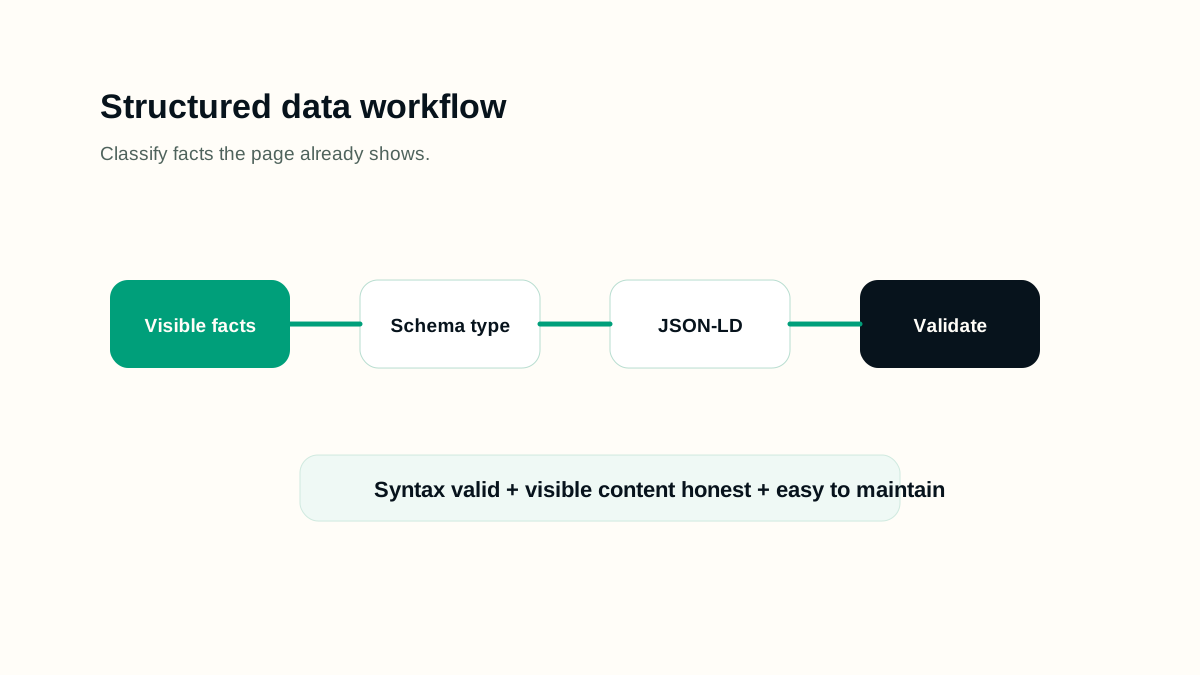
Choose schema from the page's real purpose. An article can use article-like structured data, a tool page may use software or web application context when appropriate, a local page may use local business details, and a FAQ section should only be marked up when the questions and answers are visible and useful. Validate syntax, but also validate honesty.
A practical workflow
- Identify the main entity of the page and the search feature you are trying to qualify for.
- Confirm the required and recommended properties from official documentation.
- Add JSON-LD server-side where possible so it is present in the initial HTML.
- Ensure every claim in the markup is visible or directly supported on the page.
- Validate with a structured data test before release.
- Monitor Search Console enhancements without assuming eligibility guarantees display.
Working example
Imagine the page is being prepared for a real publishing queue. The editor has one URL, one primary intent, a sitemap rule, and a follow-up date. For schema markup and structured data for seo, the useful work is to decide what must be visible before launch, what can be measured after launch, and which signals would prove that the page is helping users instead of only adding another URL.
- Write the page brief before writing the final article.
- Name the primary query group and the reader's next action.
- Check the rendered page, not only the draft data.
- Record the verification date so later reporting has context.
Implementation checklist
- The schema type matches the visible page purpose.
- Required fields are complete, accurate, and not placeholder values.
- Dates, ratings, prices, authors, and business facts are truthful.
- JSON-LD is valid and not duplicated with conflicting values.
- The page still works without rich results.
- Changes are reviewed when templates, content types, or business data change.
Decision rules
Use decision rules to keep the work honest. A rule prevents the page from becoming a collection of SEO opinions and makes the review easier for another person. The rule should explain what to do when evidence is weak, when a page is too thin, when a signal conflicts with another signal, and when the safest answer is to wait for better data.
- If the page cannot answer a clear reader need, do not publish it as indexable content.
- If the technical signal conflicts with visible content, fix the visible content or remove the signal.
- If a section only repeats the title in different words, replace it with an example, checklist, or caveat.
- If a change cannot be verified, mark it as an editorial assumption rather than a completed fix.
- If a future page is scheduled, keep it out of public links and sitemaps until the publish date.
Common mistakes
- Adding FAQ markup for hidden or generic questions.
- Using review or rating markup without real visible review data.
- Copying schema from another page type without changing meaning.
- Letting JavaScript change structured data after initial HTML in inconsistent ways.
- Treating rich result eligibility as guaranteed traffic.
How to measure it
Measure structured data by validation status, enhancement reports, error trends, and whether the markup remains accurate as content changes. A correct implementation is stable, honest, and easy to maintain across templates.
Release checklist
- Confirm the canonical URL, title, meta description, headings, and language alternates.
- Open the page on mobile and desktop to check spacing, tables, diagrams, and code blocks.
- Verify the page appears in the sitemap only when it is live.
- Check that images have useful alt text and do not create layout shift.
- Add internal links from related guides after the destination page is public.
AI review prompt
Use this prompt after you have a real URL, page draft, or crawl export. It is meant to produce fixes you can review, not automatic publishing decisions.
Act as a structured data reviewer.
Page type: [article/tool/local/product]
Page URL or HTML: [input]
Target schema: [type]
Check type fit, visible evidence, required fields, conflicting JSON-LD, validation risks, and Search Console monitoring steps.
Final review
A strong SEO page is not only optimized for a keyword. It is reachable, understandable, useful, and honest about what it can answer. Before publishing, check the rendered page, the snippet fields, internal links, indexability, and whether a reader can act without opening five more tabs.
Revisit the page when search intent changes, when the product or platform changes, when Search Console shows new query groups, or when users repeatedly need clarification. Refreshing content should make the page more accurate and useful; it should not be a cosmetic date change.