Local SEO helps people find a business, location, or service area when location changes the answer. The work is part content quality, part data accuracy, and part trust. A local page should explain who the page serves, where the work happens, what is actually offered, how people can verify the business, and what the next step is.
What this page must do
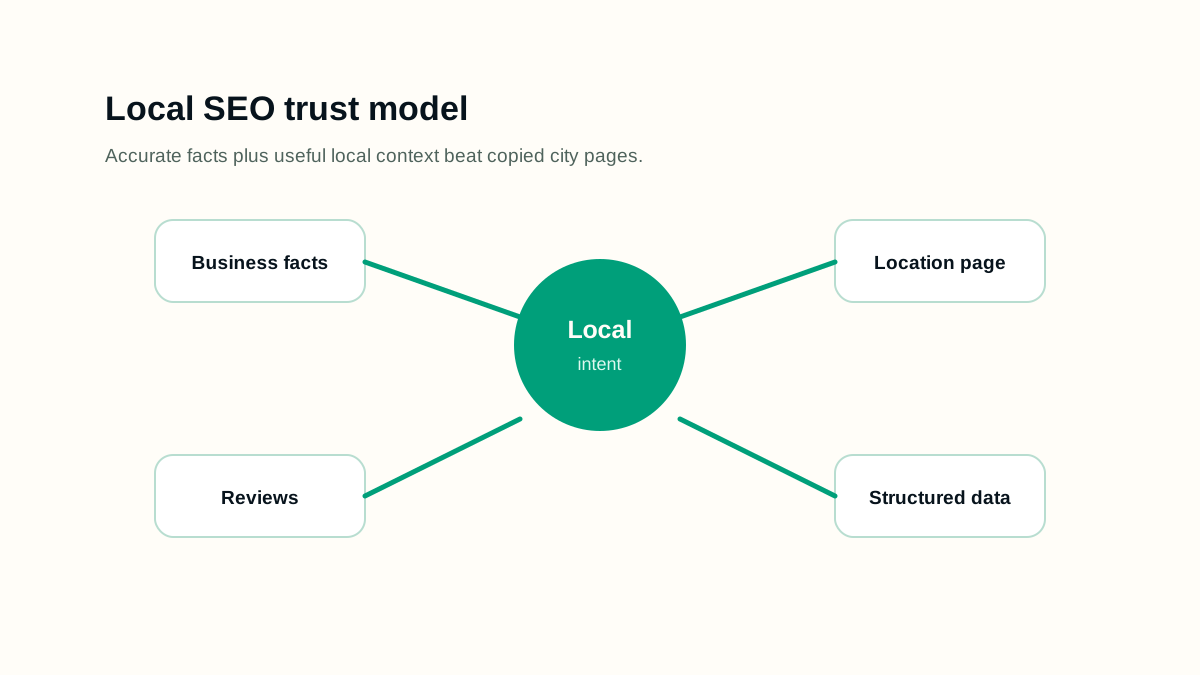
Avoid building dozens of thin location pages by swapping city names. Strong local pages include accurate business details, unique local context, useful FAQs, clear opening hours when relevant, location-specific proof, directions or service boundaries, and consistent information across public profiles. Structured data can help classify facts, but it should match visible content.
A practical workflow
- Identify the exact local intent: nearby, open now, service area, directions, comparison, or contact.
- Create one useful page per real location or meaningful service area.
- Keep name, address, phone, hours, categories, and URLs consistent wherever they appear.
- Add local proof only when it is real: photos, directions, landmarks, reviews, policies, or examples.
- Use local business structured data only for facts visible on the page.
- Measure local pages separately by query, page, country, device, and conversion path.
Working example
Imagine the page is being prepared for a real publishing queue. The editor has one URL, one primary intent, a sitemap rule, and a follow-up date. For local seo guide, the useful work is to decide what must be visible before launch, what can be measured after launch, and which signals would prove that the page is helping users instead of only adding another URL.
- Write the page brief before writing the final article.
- Name the primary query group and the reader's next action.
- Check the rendered page, not only the draft data.
- Record the verification date so later reporting has context.
Implementation checklist
- The page clearly states the location or service area without hiding it in footer text.
- Business facts match public profiles and the site footer.
- The page has unique local value, not only a rewritten generic service page.
- Structured data matches visible content and uses the most specific relevant type.
- Reviews or claims are real, dated where useful, and not invented.
- Internal links connect nearby guides, contact information, and relevant service details without becoming a link block.
Decision rules
Use decision rules to keep the work honest. A rule prevents the page from becoming a collection of SEO opinions and makes the review easier for another person. The rule should explain what to do when evidence is weak, when a page is too thin, when a signal conflicts with another signal, and when the safest answer is to wait for better data.
- If the page cannot answer a clear reader need, do not publish it as indexable content.
- If the technical signal conflicts with visible content, fix the visible content or remove the signal.
- If a section only repeats the title in different words, replace it with an example, checklist, or caveat.
- If a change cannot be verified, mark it as an editorial assumption rather than a completed fix.
- If a future page is scheduled, keep it out of public links and sitemaps until the publish date.
Common mistakes
- Publishing doorway-style pages for locations where there is no real local value.
- Using structured data to claim facts that users cannot see on the page.
- Letting old hours, phone numbers, or addresses drift across templates.
- Copying the same paragraph across every city page.
- Ignoring mobile layout when most local visits happen on small screens.
How to measure it
Measure local SEO with page-query pairs, calls or direction clicks where available, profile consistency checks, reviews over time, and whether local pages attract impressions for the intended areas. Thin city pages may create indexable URLs, but useful local pages create clearer trust and better user paths.
Release checklist
- Confirm the canonical URL, title, meta description, headings, and language alternates.
- Open the page on mobile and desktop to check spacing, tables, diagrams, and code blocks.
- Verify the page appears in the sitemap only when it is live.
- Check that images have useful alt text and do not create layout shift.
- Add internal links from related guides after the destination page is public.
AI review prompt
Use this prompt after you have a real URL, page draft, or crawl export. It is meant to produce fixes you can review, not automatic publishing decisions.
Act as a local SEO editor.
Location/service area: [area]
Page URL or draft: [URL/draft]
Review business facts, local intent, unique local value, structured data claims, internal links, mobile first screen, and thin-page risk.
Final review
A strong SEO page is not only optimized for a keyword. It is reachable, understandable, useful, and honest about what it can answer. Before publishing, check the rendered page, the snippet fields, internal links, indexability, and whether a reader can act without opening five more tabs.
Revisit the page when search intent changes, when the product or platform changes, when Search Console shows new query groups, or when users repeatedly need clarification. Refreshing content should make the page more accurate and useful; it should not be a cosmetic date change.