Keyword Cannibalization: Find and Fix Conflicts is useful when it helps a real reader or operator make a better decision, not when it adds another isolated SEO tactic. For arjns-style publishing, the page should explain the problem, show the practical workflow, name the risks, and give a repeatable way to review the result. Diagnose harmful same-intent competition rather than treating repeated words as a defect. Multiple pages can rank safely when they serve different tasks. Require intent, performance, and page-purpose evidence before using a destructive fix such as consolidation or a redirect.
Keyword overlap is not automatically cannibalization
Keyword cannibalization is harmful competition between a site's URLs for substantially the same search task. Shared vocabulary alone is not proof. Two pages may both appear for a query because one teaches a process and another supplies a tool, comparison, or reference. Confirm a problem only when the pages have materially overlapping intent and evidence shows that split signals, unstable URL selection, or a confusing destination is weakening the combined reader and search outcome.
Evidence required before changing a URL
A defensible diagnosis combines page purpose, query behavior, internal signals, and preservation planning.
- Write each page's audience, task, format, unique value, and desired action side by side.
- Compare query-to-page performance over equivalent periods rather than reacting to one ranking snapshot.
- Inventory useful sections, links, conversions, and backlinks before consolidation or redirection.
Confirm whether two URLs truly conflict
Start by separating the user need from the search engine signal. The user need is what the page must solve. The search signal is how crawlers and ranking systems understand that solution. If the page only chases the signal, it becomes thin. If it only helps the reader but hides the structure, it can be harder to discover. The right answer is a clear page with crawlable HTML, precise metadata, useful examples, internal links, and a measurable follow-up.
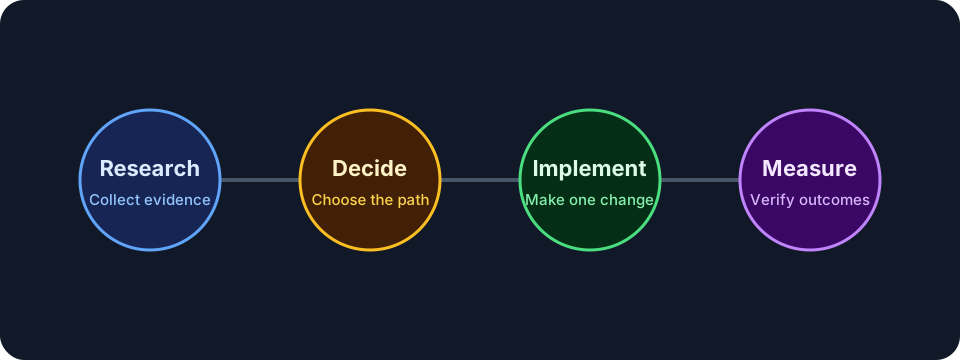
Build a query-to-page conflict worksheet
- Start with a measurable query or topic concern rather than scanning for repeated words alone.
- List relevant URLs from search performance, analytics, a crawl, internal search, and editorial records.
- Write the task, audience, format, and expected outcome for every page side by side.
- Compare query-to-page visibility and equivalent periods, noting missing or anonymized data.
- Review titles, headings, anchors, canonicals, sitemaps, navigation, backlinks, and conversions.
- Choose the least destructive remedy: keep, differentiate, relink, consolidate, redirect, or correct a canonical.
- Document the expected search intent, the page promise, and the verification method before publishing.
- Review the rendered page on mobile because cramped layouts, hidden tables, or broken controls can turn good content into a poor experience.
Worked example: keep, split, or consolidate
If two guides use the same keyword but one teaches a process and the other provides an interactive tool, keep both when each performs its own task. If two near-duplicate guides alternate for the same query, split internal links, and offer no distinct outcome, consolidate their strongest material and redirect the obsolete URL. Save combined impressions, clicks, links, and conversions before acting, then review equivalent periods after recrawling.
- Write the page brief before writing the final article.
- Name the primary query group and the reader's next action.
- Check the rendered page, not only the draft data.
- Record the verification date so later reporting has context.
Cannibalization evidence checklist
- The title, H1, summary, and first section describe the same practical outcome.
- The page includes examples or decision rules a reader can apply immediately.
- Important links are crawlable anchors with natural context.
- The sitemap includes the page only when it is live and canonical.
- The page avoids claims that cannot be verified from visible content or data.
- The review date, publish date, and next measurement point are clear to the editor.
Safe remedies and destructive changes
Use decision rules to keep the work honest. A rule prevents the page from becoming a collection of SEO opinions and makes the review easier for another person. The rule should explain what to do when evidence is weak, when a page is too thin, when a signal conflicts with another signal, and when the safest answer is to wait for better data.
- If the page cannot answer a clear reader need, do not publish it as indexable content.
- If the technical signal conflicts with visible content, fix the visible content or remove the signal.
- If a section only repeats the title in different words, replace it with an example, checklist, or caveat.
- If a change cannot be verified, mark it as an editorial assumption rather than a completed fix.
- If a future page is scheduled, keep it out of public links and sitemaps until the publish date.
When not to merge or redirect
Do not merge pages merely because a crawler reports duplicate terms or both rank for a broad query. Keep both when they satisfy distinct intents, audiences, formats, or journey stages and make that distinction explicit in titles and internal links. Avoid a redirect when no genuinely equivalent destination exists; improving, retiring with an appropriate status, or leaving a useful historical reference may be more honest.
Cannibalization diagnosis mistakes
- Calling every keyword overlap cannibalization.
- Merging pages that serve different reader intents.
- Using canonical tags as substitutes for redirects.
- Redirecting distinct pages to a broad homepage.
- Measuring immediately and declaring the change a success or failure.
Measure combined page performance
Measure this work with a short feedback loop: crawl status, sitemap visibility, impressions for the intended query group, clicks and CTR when snippets change, engagement on the page, and whether the reader continues to a related guide or tool. Do not judge success from a single day of data; search systems, crawling, and reporting all move on different timelines.
Cannibalization evidence checklist: release checks
- Confirm the canonical URL, title, meta description, headings, and language alternates.
- Open the page on mobile and desktop to check spacing, tables, diagrams, and code blocks.
- Verify the page appears in the sitemap only when it is live.
- Check that images have useful alt text and do not create layout shift.
- Add internal links from related guides after the destination page is public.
Recommendation: choose the least destructive fix: AI review prompt
Use this prompt after you have a real URL, page draft, or crawl export. It is meant to produce fixes you can review, not automatic publishing decisions.
Act as a careful SEO implementation reviewer.
Page/topic: Keyword Cannibalization: Find and Fix Conflicts
URL or draft: [paste URL or content]
Search intent: [intent]
Review: crawlability, title, meta description, headings, content depth, examples, internal links, structured data/canonical needs, mobile UX, and measurement plan.
Return prioritized fixes with exact page sections to change.
Frequently asked questions
Is ranking two pages for one query always bad?
No. It can be useful when the pages serve distinct intents and both help readers.
How is a conflict confirmed?
Compare page intent, query-to-page visibility, combined performance, internal signals, and the outcome each page provides.
Should competing pages be merged?
Only when they serve the same task and one destination can preserve their useful information.
Is cannibalization duplicate content?
Not necessarily. Duplicate content concerns similarity; cannibalization concerns harmful competition for the same intent.
Recommendation: choose the least destructive fix
A strong SEO page is not only optimized for a keyword. It is reachable, understandable, useful, and honest about what it can answer. Before publishing, check the rendered page, the snippet fields, internal links, indexability, and whether a reader can act without opening five more tabs.
Revisit the page when search intent changes, when the product or platform changes, when Search Console shows new query groups, or when users repeatedly need clarification. Refreshing content should make the page more accurate and useful; it should not be a cosmetic date change.